

Introduction
Software testing is no longer just a phase in the development lifecycle—it is a strategic function that directly impacts product quality, customer satisfaction, and business outcomes. With increasing system complexity, faster release cycles, and growing user expectations, traditional testing approaches struggle to keep up.
Artificial Intelligence (AI) is transforming this landscape. AI-powered end-to-end (E2E) test automation is enabling teams to move from reactive testing to predictive quality engineering—reducing effort, improving accuracy, and accelerating delivery.
This article provides a practical, experience-driven perspective on how AI is reshaping end-to-end test automation and how organizations can leverage it effectively.
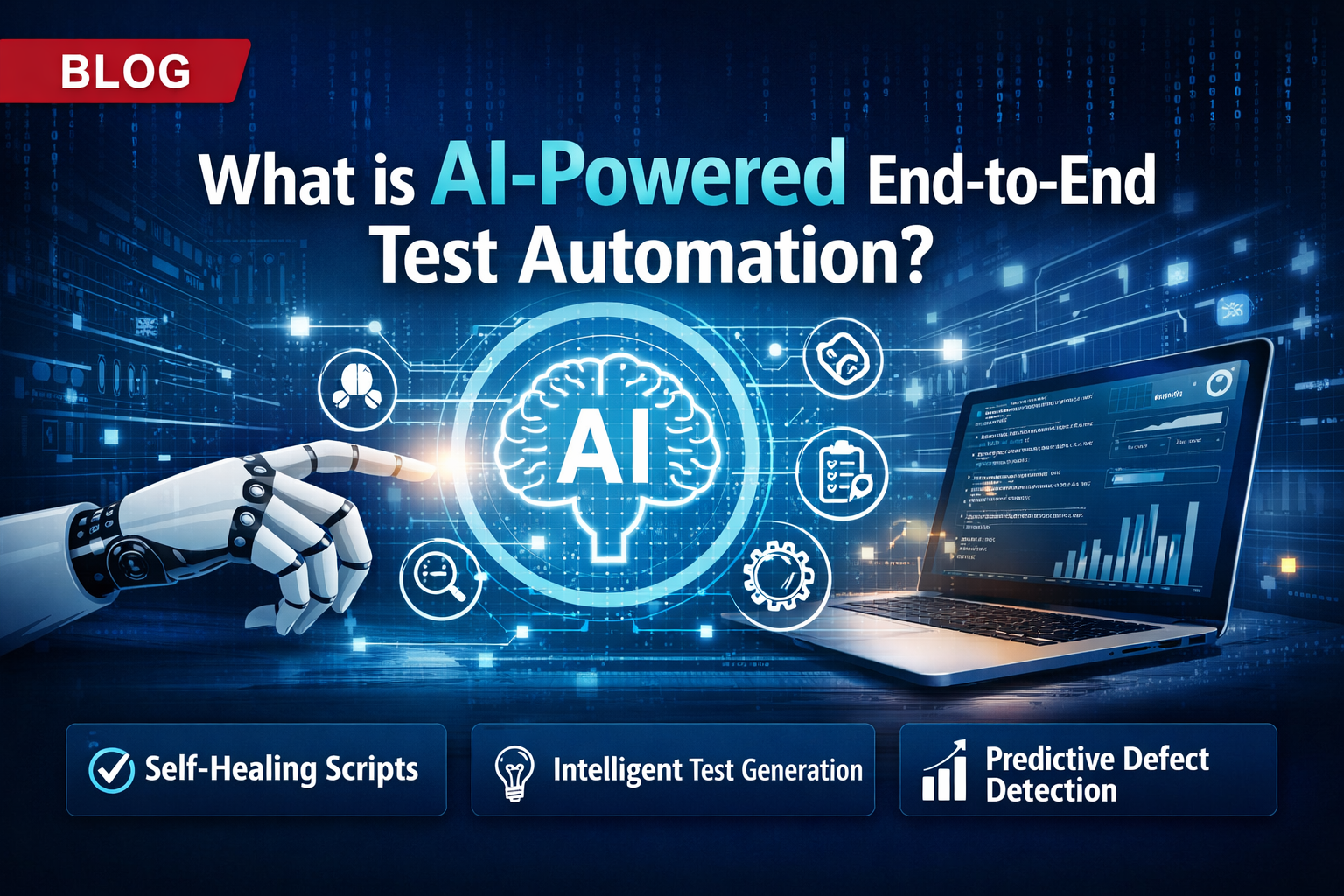
What is AI-Powered End-to-End Test Automation?
End-to-end testing validates complete workflows across systems, ensuring that applications function correctly from the user’s perspective. AI enhances this by introducing:
- Self-learning test scripts
- Intelligent test generation
- Dynamic object recognition
- Predictive defect detection
- Automated maintenance
Instead of relying solely on predefined rules, AI models analyze patterns, learn from historical data, and continuously improve test execution.
Why Traditional Automation Falls Short
While automation frameworks like Selenium and Cypress have been widely adopted, they often face limitations:
- High maintenance due to UI changes
- Fragile locators leading to test failures
- Limited test coverage due to manual script creation
- Lack of intelligence in failure analysis
AI addresses these challenges by introducing adaptability and decision-making capabilities into the testing process.
Key Capabilities of AI in Test Automation
1. Self-Healing Test Scripts
AI can automatically detect UI changes and update locators without human intervention. This significantly reduces maintenance overhead.
Example:
When an element ID changes, AI identifies alternative attributes (text, position, hierarchy) to continue execution.
2. Intelligent Test Case Generation
AI analyzes:
- User behavior
- Production logs
- Historical defects
It then generates high-priority test cases, focusing on risk areas.
Business Impact:
- Improved coverage
- Reduced manual effort
- Faster regression cycles
3. Visual Testing with AI
AI-based visual validation compares UI elements pixel-by-pixel and detects anomalies that traditional assertions miss.
This is critical for:
- UI/UX consistency
- Cross-browser validation
- Responsive design testing
4. Predictive Defect Analysis
AI models identify patterns in past defects and predict:
- High-risk modules
- Likely failure points
- Areas requiring deeper testing
This shifts testing from reactive to proactive.
5. Smart Test Execution
AI prioritizes test execution based on:
- Code changes
- Risk impact
- Historical failures
This enables faster feedback cycles in CI/CD pipelines.
Real-World Use Case
Consider a fintech application with frequent UI updates and regulatory changes.
Traditional Approach:
- 3–5 days regression cycle
- Frequent test failures due to locator changes
- High manual intervention
AI-Powered Approach:
- Regression cycle reduced to hours
- Self-healing scripts minimize failures
- AI prioritizes high-risk transaction flows
Outcome:
- Faster releases
- Improved defect detection
- Reduced testing cost
Popular AI Testing Tools
Some widely adopted AI-powered testing platforms include:
- Testim
- Functionize
- Mabl
- Applitools (for visual AI testing)
- Katalon AI features
Each tool offers varying levels of AI integration, from smart locators to full autonomous testing.
Challenges to Consider
Despite its advantages, AI-powered testing is not without challenges:
- Initial setup and learning curve
- Dependence on quality training data
- Tool selection complexity
- Integration with existing frameworks
Organizations must evaluate ROI and align AI adoption with their testing strategy.
Best Practices for Implementation
To successfully adopt AI in test automation:
- Start Small
Begin with high-impact areas such as regression testing or UI validation. - Integrate with CI/CD
Ensure AI testing aligns with DevOps pipelines. - Focus on Data Quality
AI is only as effective as the data it learns from. - Combine Human + AI Intelligence
Use AI to augment—not replace—test engineers. - Measure ROI Continuously
Track metrics such as defect leakage, execution time, and maintenance effort.
The Future of Software Testing
AI is moving testing toward:
- Autonomous testing systems
- Continuous quality engineering
- Zero-maintenance automation frameworks
Test engineers will evolve into quality strategists, focusing more on designing intelligent systems rather than writing repetitive scripts.
Conclusion
AI-powered end-to-end test automation is not a trend—it is a fundamental shift in how software quality is ensured. Organizations that embrace this transformation will gain a competitive advantage through faster releases, better quality, and optimized costs.
However, success depends on a balanced approach that combines AI capabilities with human expertise, strategic planning, and continuous improvement.
About Stepin2IT
At Stepin2IT, we specialize in practical, industry-focused training in software testing, business analysis, and IT skills. Our goal is to equip professionals with real-world knowledge that aligns with evolving technologies like AI and automation.
The Future of Software Testing
AI is driving a shift toward autonomous testing and continuous quality engineering. Test professionals are evolving into strategic roles focused on designing intelligent, scalable testing ecosystems.
Conclusion
AI-powered end-to-end test automation is redefining how organizations ensure software quality. Those who adopt it strategically will gain a competitive edge through efficiency, scalability, and improved reliability.
Call to Action: Advance Your Career with Stepin2IT
If you are looking to build job-ready skills in AI-powered software testing and test automation Toronto , Stepin2IT offers practical, hands-on training designed for real-world success.
What You Will Gain with Software testing training with job assistance Toronto :
- End-to-end automation framework development
- Hands-on experience with modern tools and AI-driven testing approaches
- Real project scenarios aligned with industry needs
- Interview preparation and career guidance
Take the Next Step:
- Enroll in our Software Testing & Automation Program
- Upgrade your skills with AI-driven testing techniques
- Get mentored by industry professionals
Visit Stepin2IT.com to explore programs and start your journey toward becoming a high-demand QA professional.