

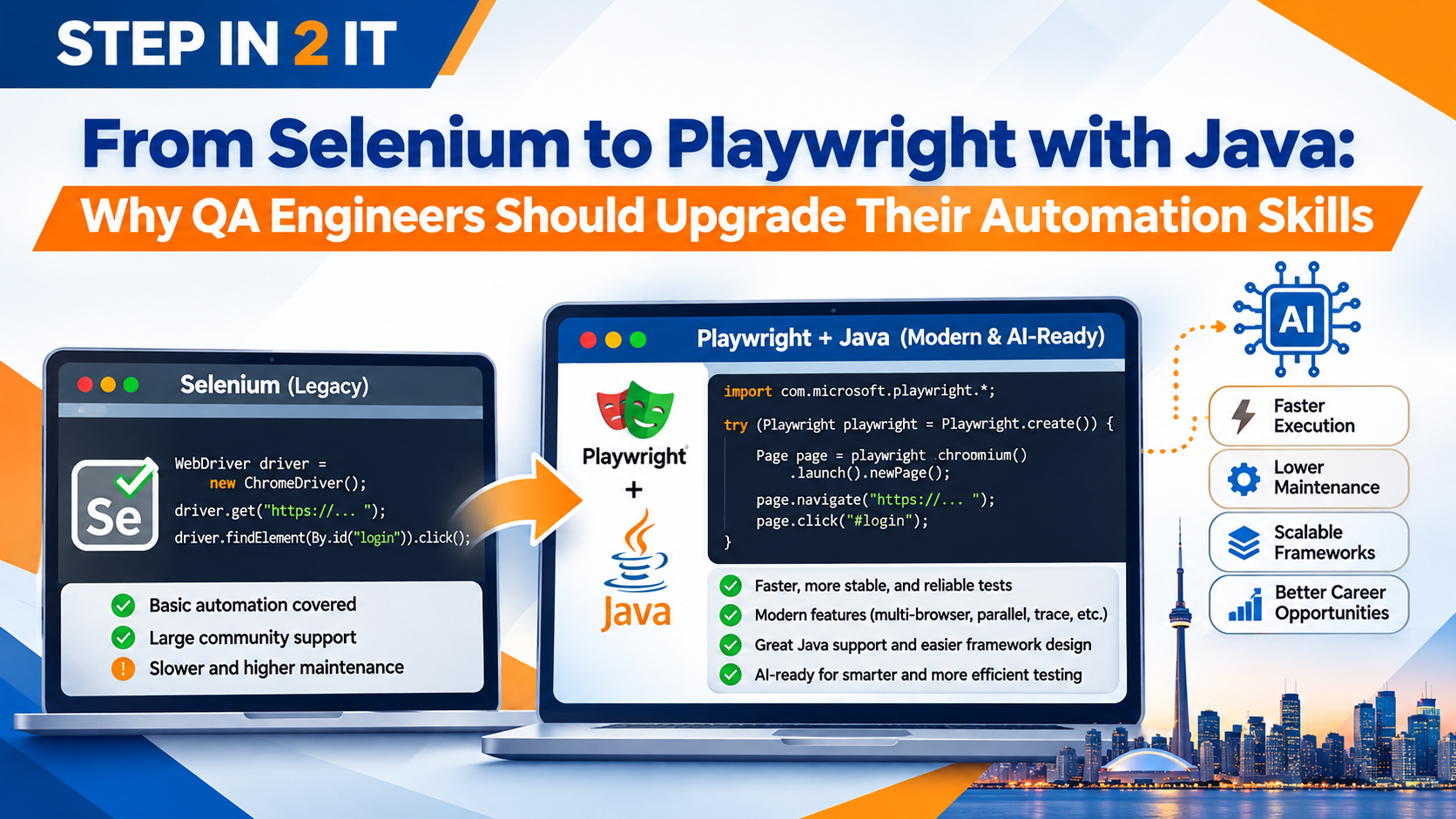
Explore why Selenium professionals are upgrading their skills with Playwright, Java and AI-assisted test automation.

For more than a decade, Selenium has been one of the most widely used tools for web application automation. Thousands of QA professionals have built successful careers using Selenium WebDriver with Java, TestNG, JUnit, Maven and Page Object Model (POM).
However, software development has changed significantly. Applications are more dynamic, release cycles are shorter, and organizations expect QA teams to deliver faster feedback without compromising software quality.
This is where Playwright enters the picture.
Playwright is a modern browser automation framework that supports Java, JavaScript, TypeScript, Python and .NET. Its capabilities include automatic waiting, isolated browser contexts, cross-browser testing, API testing and detailed execution traces.
For Selenium professionals, learning Playwright with Java is not about abandoning everything they already know. It is about building on their existing Java and automation knowledge and adapting to the next generation of test automation.
1. Why Are QA Teams Looking Beyond Selenium?
Selenium remains a mature and widely supported automation framework. Its WebDriver architecture, browser compatibility and Selenium Grid capabilities continue to make it a strong choice for enterprise automation.
However, traditional Selenium frameworks often require additional engineering to handle certain challenges.
- Synchronization problems: QA engineers frequently write explicit waits to handle elements that load dynamically.
- Flaky automation: Timing differences, asynchronous requests and changing page elements can cause inconsistent test results.
- Framework maintenance: Large Selenium frameworks can become difficult to maintain when reusable components and synchronization strategies are not designed properly.
- Debugging failures: Investigating failed tests may require reviewing screenshots, logs, browser output and execution history from multiple sources.
- Modern application testing: Applications increasingly involve dynamic interfaces, multiple browser contexts, API interactions and complex authentication workflows.
These challenges do not mean Selenium is outdated or incapable. Selenium 4 continues to evolve, including improvements to browser management, Grid and WebDriver BiDi. However, Playwright offers an integrated approach to several of these automation challenges.
2. Selenium vs. Playwright with Java: What Has Changed?
The biggest difference is not simply the programming language or syntax. It is the way the frameworks approach browser automation and test reliability.
A. Automatic waiting instead of managing every synchronization point
In Selenium, testers commonly implement explicit waits using WebDriverWait and ExpectedConditions.
WebDriverWait wait = new WebDriverWait(
    driver, Duration.ofSeconds(10)
);

WebElement loginButton = wait.until(
    ExpectedConditions.elementToBeClickable(
        By.id("login")
    )
);

loginButton.click();
With Playwright Java:
Locator loginButton = page.locator("#login");

loginButton.click();
Playwright automatically checks whether an element is actionable before performing supported actions. Its locator assertions can also retry until the expected condition is satisfied. This reduces the need for manually adding synchronization logic throughout test scripts.
It does not eliminate every possible flaky test, but it helps address a major source of automation instability.
B. Better test isolation through browser contexts
In traditional Selenium frameworks, QA engineers often need to manage browser sessions, cookies, local storage and cleanup between tests.
Playwright introduces BrowserContext, which provides an isolated browser session.
Browser browser = playwright.chromium().launch();

BrowserContext context = browser.newContext();

Page page = context.newPage();

page.navigate("https://example.com");
Different browser contexts can run within the same browser process while maintaining separate cookies, sessions and local storage.
This is particularly useful when testing multiple user roles, different login accounts, independent shopping sessions and authentication workflows.
C. More effective debugging with Trace Viewer
One of the most useful features for automation engineers is Playwright Trace Viewer. When a test fails, engineers can examine recorded execution information, including individual test actions, DOM snapshots, screenshots, network activity, console messages and execution timelines.
Instead of relying exclusively on screenshots and text logs, testers can investigate what happened before, during and after an action. This makes root-cause analysis more structured and can reduce the time spent investigating difficult failures.
D. Cross-browser testing
Playwright supports Chromium, Firefox and WebKit through a common API. This allows QA engineers to develop tests that can be executed against multiple browser engines.
Selenium also provides extensive cross-browser support, including browser implementations such as Chrome, Firefox, Edge and Safari. The choice depends on the application's browser requirements. Organizations requiring particular branded browser versions or specialized browser environments may still benefit from Selenium.
3. Why Selenium Professionals Should Learn Playwright with Java
For experienced automation testers, learning Playwright with Java offers a practical transition because they can retain many of their existing programming skills.
Instead of starting from zero, Selenium professionals can transfer their knowledge of:
- Java fundamentals and object-oriented programming.
- Collections, exception handling and interfaces.
- TestNG and JUnit.
- Maven and Gradle.
- Page Object Model.
- Test data management.
- API testing concepts.
- Git and CI/CD integration.
- Test planning and defect management.
The main learning requirement is understanding Playwright's architecture, APIs, locators, browser contexts and execution model.
| Existing Selenium knowledge | New Playwright learning area |
|---|---|
| WebDriver | Playwright, Browser and Page |
| WebElement | Locator |
| WebDriverWait | Automatic waiting and retrying assertions |
| ChromeDriver | BrowserType and browser launch |
| Test setup and teardown | BrowserContext lifecycle |
| Screenshot capture | Trace Viewer and execution tracing |
| Selenium Grid | Parallel execution and distributed CI strategies |
| REST Assured | Playwright APIRequestContext and API testing |
| Page Object Model | Playwright-based reusable page objects |
The objective is not to replace every existing framework component. It is to understand which practices remain useful and which ones should be redesigned.
4. How Playwright with Java Supports Modern Automation Frameworks
A modern automation framework needs more than test scripts. It should be maintainable, reusable, scalable and suitable for continuous integration.
Essential framework components
- Java and Maven: Java provides the programming foundation, while Maven manages dependencies, builds and project execution.
- Playwright browser automation: The Playwright Java library provides APIs for browser interaction, navigation, locators, screenshots, downloads, dialogs and other browser operations.
- TestNG or JUnit: These frameworks can manage test execution, lifecycle methods, assertions, grouping and parallel execution for Java-based automation projects.
- Page Object Model: Reusable page classes help separate application interactions from test scenarios.
- API testing: Playwright's APIRequestContext can be used to send HTTP requests and validate application APIs without opening a browser.
- Reporting and debugging: Execution logs, screenshots, traces and reporting integrations help teams investigate failures.
- CI/CD integration: Integration with Jenkins, GitHub Actions or Azure DevOps allows automated tests to run as part of the software delivery pipeline.
Together, these components provide a foundation for building maintainable enterprise automation frameworks.
5. The Role of AI in the Next Generation of Test Automation
The transition from Selenium to Playwright is also taking place alongside the growing adoption of artificial intelligence in software testing. AI-assisted development tools can help QA engineers write code, generate test scenarios, explain failures and improve framework development.
AI-assisted test script development
AI coding assistants can help convert manual test scenarios into Java automation scripts, suggest reusable methods and generate initial Page Object classes.
Intelligent test scenario generation
AI can assist in identifying additional test conditions based on user stories, acceptance criteria and application workflows.
Faster debugging
Engineers can use AI tools to interpret exception messages, review execution logs and suggest possible reasons for failed tests.
Test data preparation
AI can help generate structured test data and identify missing edge cases, subject to privacy and data governance requirements.
AI-assisted browser workflows
Playwright's accessibility snapshots and its ecosystem of browser automation tools can support AI-assisted workflows where agents interact with structured page information.
It is important to understand that AI does not automatically make tests reliable. QA professionals must still validate generated scripts, review assertions, protect sensitive information and understand the underlying application behaviour.
The future belongs to testers who can combine automation engineering, Java programming, quality analysis and responsible AI-assisted development.
6. What Are Employers Looking for in QA Automation Engineers in Canada?
The Canadian technology job market is increasingly reflecting the need for professionals who understand both traditional automation and modern testing technologies.
Toronto-area job advertisements can provide useful examples of the skills employers request. Before publishing specific employer names, job titles or posting dates, verify that each vacancy is still publicly available and accurately represented. Commonly requested skills in automation roles include:
- Java-based automation framework development.
- Playwright and Selenium browser automation.
- UI and API testing.
- TestNG or JUnit.
- Backend validation and test data management.
- CI/CD and version control.
These requirements demonstrate an important point: employers are not necessarily looking for candidates who have abandoned Selenium. They increasingly value professionals who can work with existing Selenium frameworks while developing automation solutions using newer technologies.
For QA professionals in Toronto, Mississauga, Brampton, Scarborough, North York and the wider Greater Toronto Area, developing practical Playwright skills can strengthen their technical profile.
7. A Practical Learning Roadmap: Selenium to Playwright with Java
If you already have Selenium experience, a structured learning approach can make the transition easier.
- Strengthen Java fundamentals: Review object-oriented programming, collections, exception handling, interfaces, streams and reusable coding practices.
- Understand Playwright architecture: Learn Playwright, Browser, BrowserContext, Page, Locator and the Java API.
- Master locators and synchronization: Practice role-based locators, text locators, CSS selectors, automatic waiting and web-first assertions.
- Build a Java automation framework: Create a Maven-based project and integrate Playwright with TestNG or JUnit. Implement reusable page objects, configuration management and test data handling.
- Learn advanced automation: Explore multiple browser contexts, file uploads, downloads, alerts, frames, authentication, network interception and API testing.
- Integrate CI/CD: Execute tests through Jenkins or GitHub Actions and learn how to publish execution reports and preserve trace files.
- Explore AI-assisted automation: Use AI coding assistants to generate initial scripts, improve test coverage and investigate failures while maintaining manual technical review.
A practical project involving login workflows, shopping carts, form submissions, API validation and end-to-end regression testing can help demonstrate these skills to potential employers.
8. Should You Completely Replace Selenium with Playwright?
Not necessarily. The right automation technology depends on the application, existing infrastructure, browser requirements, team expertise and long-term maintenance costs.
Selenium remains a strong option for organizations with established WebDriver frameworks, extensive Grid infrastructure or specialized browser requirements.
Playwright can be an excellent choice for modern web application automation where its auto-waiting, browser contexts, debugging tools and API capabilities offer practical advantages.
For QA professionals, the strongest strategy is to understand both technologies. Rather than treating Selenium and Playwright as competing career choices, consider them complementary skills that help you adapt to different enterprise environments.
9. Upgrade Your QA Automation Skills with STEP IN 2 IT
At STEP IN 2 IT, we recognize that the expectations placed on QA automation professionals are changing.
Our Playwright with Java training is designed to help candidates develop practical automation skills using Java and modern browser automation techniques.
What you can learn
- Java programming for automation.
- Playwright architecture and browser automation.
- Locators and automatic waiting.
- TestNG/JUnit integration.
- Page Object Model and framework development.
- Cross-browser automation.
- API testing.
- Debugging and execution reporting.
- CI/CD fundamentals.
- AI-assisted automation practices.
Whether you are an experienced Selenium tester looking to upgrade your skills, a manual QA professional moving into automation, or a new graduate preparing for a technology career, developing practical automation knowledge can help you become more competitive.
We also offer job placement assistance to support eligible candidates as they prepare for employment opportunities.
Ready to Move Beyond Traditional Selenium Automation?
Explore Playwright with Java training at STEP IN 2 IT and start building the skills required for modern QA automation roles in Toronto and across Canada.
Learn Java. Master Playwright. Embrace AI-assisted testing.
Visit STEP IN 2 IT to learn more about our IT training and career services.
Frequently Asked Questions
1. Should Selenium testers learn Playwright?
Yes. Learning Playwright can help Selenium professionals expand their automation capabilities and prepare for roles requiring modern browser automation technologies. Selenium knowledge remains valuable.
2. Can I learn Playwright with Java if I already know Selenium with Java?
Absolutely. Your Java programming, object-oriented programming, testing concepts and framework development experience provide a useful foundation. You will need to learn Playwright's architecture and APIs.
3. Is Playwright better than Selenium?
Neither framework is universally better. Playwright offers integrated auto-waiting, browser contexts and Trace Viewer, while Selenium offers a mature WebDriver ecosystem and extensive browser and infrastructure compatibility. The right choice depends on project requirements.
4. Does Playwright support Java?
Yes. Playwright provides official Java bindings, allowing developers and QA engineers to automate browsers using Java.
5. Can Playwright be used for API testing?
Yes. Playwright Java provides APIRequestContext for sending HTTP requests, validating responses and preparing or checking server-side application state.
6. Is Playwright useful for QA jobs in Toronto?
Playwright, Java, API automation, framework development and CI/CD are relevant skills in modern automation roles. Developing these skills can help candidates align their technical capabilities with employer requirements.
7. Do I need to forget Selenium before learning Playwright?
No. Understanding Selenium remains beneficial, particularly when working with enterprise applications that maintain existing Selenium automation frameworks. Learning both technologies provides greater flexibility.
Final Thoughts
The evolution of test automation is not about replacing one tool with another overnight. It is about adapting to changing application architectures, improving test reliability and developing the skills required to support faster software delivery.
Selenium has provided a strong foundation for automation engineering. Playwright with Java gives QA professionals another powerful technology to add to their skill set.
For Selenium testers, the next career step may not be starting over. It may simply be upgrading what they already know.
Learn Java. Master Playwright. Embrace AI-assisted testing. Build your future in QA automation with STEP IN 2 IT.