

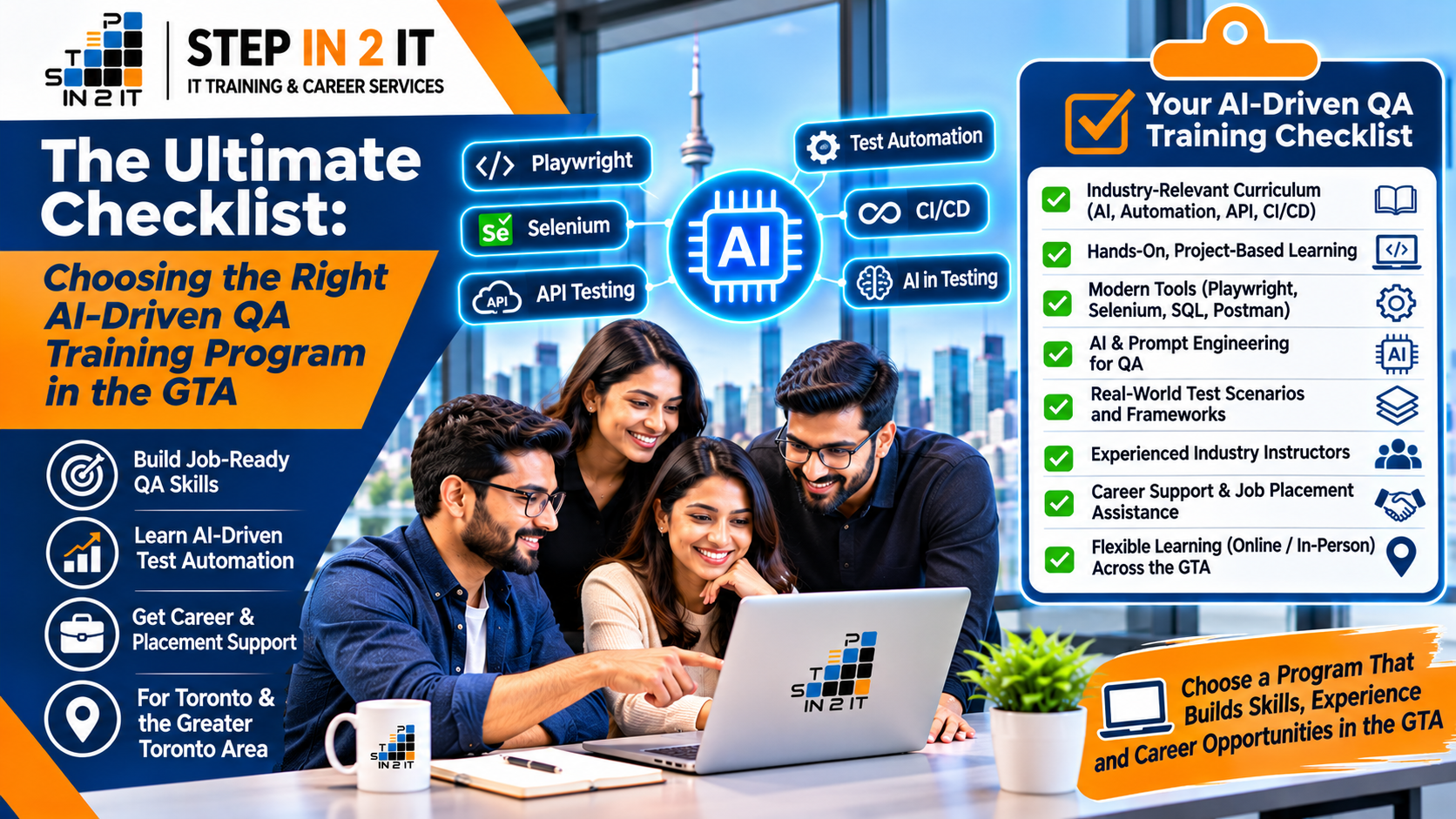
Software quality assurance is changing quickly. Organizations are adopting automation, cloud platforms, continuous integration and artificial intelligence (AI) to improve how they build and test software. As a result, aspiring QA professionals need more than a short introduction to manual testing. They need a practical foundation in software quality, experience with modern tools and the ability to use AI responsibly.
If you are searching for QA training in Toronto, Brampton, Mississauga, Scarborough, North York, Markham, Vaughan or elsewhere in the Greater Toronto Area, the number of available courses can make choosing difficult. Some programs focus mainly on theory, while others emphasize automation tools without explaining the testing principles behind them. A strong program should connect the fundamentals, technical skills, realistic practice and career preparation.
This checklist will help you evaluate an AI-driven QA training program, ask better questions before enrolling and decide whether a course matches your learning goals.
1. Start With Your Career Goal
Before comparing course fees or tools, identify the kind of role you want to work toward. QA is a broad field, and different positions emphasize different capabilities.
- Manual QA Tester: Requirements analysis, test design, exploratory testing, defect reporting and functional validation.
- QA Analyst: Testing fundamentals, business-process understanding, documentation, execution and stakeholder communication.
- QA Automation Engineer: Automated tests using programming languages, frameworks and CI/CD tools.
- API Tester: Interfaces, requests, responses, authentication, data contracts and integrations.
- Quality Engineer: Test strategy, automation, reliability, pipelines and quality practices throughout development.
Entry-level learners do not need to master every specialization immediately. A good pathway should establish a solid QA foundation and then introduce automation and AI skills in a logical sequence.
2. The Ultimate QA Training Program Checklist
Use this checklist when reviewing a course brochure, speaking with an instructor or attending a training provider's information session.
A. Software Testing Fundamentals
- Does the program explain the Software Development Life Cycle (SDLC) and Software Testing Life Cycle (STLC)?
- Does it cover test planning, test scenarios, test cases, test data and test execution?
- Will you learn functional, regression, smoke, sanity, integration and exploratory testing?
- Does it teach how to interpret requirements and identify unclear acceptance criteria?
- Will you practise writing defect reports with reproducible steps, expected and actual results, and evidence?
- Does it explain severity, priority, defect lifecycle and retesting?
Automation is only as effective as the test logic behind it. If a course skips testing fundamentals and moves directly to scripts, you may learn tool commands without understanding what should be tested or why.
B. Modern Automation Tools
- Does the curriculum include a browser automation framework such as Playwright or Selenium?
- Will you learn locators, assertions, waits, test organization and reusable automation patterns?
- Does the course cover dynamic elements, tables, forms, dialogs and authentication?
- Will you investigate failed tests using traces, screenshots, logs and debugging tools?
- Does it discuss flaky tests, test isolation, maintainability and reliable execution?
- Will you build and run an automation project yourself rather than only watch demonstrations?
Ask which framework is taught, which language is used and whether the exercises reflect current framework practices. Tool names matter less than the quality of the practical learning.
C. API Testing and Database Validation
- Does the program introduce HTTP methods, status codes, headers, JSON and REST APIs?
- Will you practise API testing with a tool such as Postman?
- Does it cover positive, negative, boundary and authorization test scenarios?
- Will you learn SQL queries, filtering, joins and basic data validation?
- Does it explain how to compare application behaviour with stored data and API responses?
- Are integration testing and data consistency included?
API and SQL skills help QA professionals test beyond the user interface. They are useful when investigating data issues, validating integrations and checking whether a workflow has produced the expected result.
D. Practical AI and Prompt Engineering for QA
- Does the program explain realistic uses and limitations of generative AI in software testing?
- Will you practise writing prompts that turn requirements into draft test scenarios and cases?
- Does it show how AI can suggest edge cases, negative tests and boundary conditions?
- Will you use AI to explain code, draft automation and help interpret sanitized logs?
- Does the course teach you to verify AI-generated assertions, scripts and test results?
- Does it address hallucinations, bias, incomplete context, privacy and responsible use?
- Will you learn when not to use AI and when human review is essential?
A course should not present AI as a replacement for QA thinking. AI can speed up drafting and analysis, but a tester must check whether suggestions match the requirements, application behaviour and business risk.
E. CI/CD and Team Workflows
- Does the program introduce version control with Git and a platform such as GitHub?
- Will you understand how automated tests fit into a CI/CD pipeline?
- Does it introduce build verification, test reports and failure investigation?
- Will you learn basic Agile or Scrum concepts and how QA works with developers and product teams?
- Does it explain how test results and defects are communicated to stakeholders?
F. Real-World Projects and Portfolio Development
- Will you complete projects based on realistic web applications or business workflows?
- Will you create manual test cases, execute tests and document defects?
- Will you build an API testing collection and a database validation exercise?
- Will you create an automation framework or structured automation project?
- Will you include AI-assisted test design and show how you reviewed the output?
- Can you publish appropriate project work in a GitHub portfolio without exposing confidential information?
- Will an instructor review your work and provide actionable feedback?
A portfolio gives you something concrete to discuss in interviews. A certificate can show course completion, but a well-documented project can help demonstrate how you approach a testing problem.
G. Instructor Experience and Learning Support
- Can the provider explain the instructor's relevant QA, automation or software development experience?
- Are classes interactive, with time for questions and guided practice?
- Can learners receive feedback when they get stuck with code or test design?
- Are course materials, exercises and tool instructions kept current?
- Is there a clear process for missed classes, technical issues and additional learning support?
- Can you speak with an advisor or attend an orientation before committing?
H. Career Preparation and Job Placement Assistance
- Does the program help translate projects and skills into a QA-focused résumé?
- Will you practise explaining test cases, defects, automation code and project decisions?
- Are mock interviews or technical interview exercises included?
- Does the provider offer job search guidance and support identifying suitable roles?
- Is job placement assistance clearly explained, including what is and is not included?
- Are employment claims, placement statistics or guarantees supported by written terms and verifiable information?
Be careful with statements such as “guaranteed job,” “100% placement” or “employment in a few weeks.” Ask what the provider means, what conditions apply, how results are measured and whether the promise is written into the agreement. No training course can guarantee that an employer will hire a particular learner.
I. Schedule, Delivery Format and Accessibility
- Can you choose online, in-person or hybrid learning where available?
- Do the class schedule and total duration fit your work, family and study commitments?
- Are computer, software and internet requirements explained in advance?
- Are recordings or make-up options available, and what are the conditions?
- Can you access exercises and learning resources after the sessions?
- Is the training accessible from your location across the GTA?
J. Fees, Contract and Student Policies
- Is the full tuition clearly stated, including applicable taxes and additional charges?
- Do you understand the payment schedule, deposit and refund policy?
- Are course duration, class hours, topics and deliverables documented?
- Are software subscriptions, exam fees or optional services included or extra?
- Are cancellation, deferral, attendance and certificate policies available in writing?
- Do you understand exactly what career support or placement assistance includes?
3. Compare Programs Using a Simple Scorecard
After reviewing two or three programs, use a scorecard to compare them consistently. Give each category a score from 1 to 5, where 1 means the course does not adequately address the area and 5 means it provides strong, practical coverage. The weights below are a suggested evaluation model, not an industry standard.
| Evaluation category | Suggested weight | What a strong program demonstrates |
|---|---|---|
| Testing fundamentals | 15% | Structured test design, execution, defect reporting and risk awareness |
| Automation tools | 15% | Hands-on work with a relevant framework and maintainable scripts |
| API and SQL | 12% | Practical API validation and database testing exercises |
| AI and prompt engineering | 12% | Useful AI workflows, output verification and responsible-use practices |
| Projects and portfolio | 15% | End-to-end projects with instructor feedback and documented outcomes |
| CI/CD and collaboration | 8% | Git, pipeline concepts, Agile teamwork and test reporting |
| Instructor and learning support | 8% | Relevant experience, accessible guidance and current materials |
| Career preparation | 10% | Résumé guidance, mock interviews and clearly described job support |
| Value and transparency | 5% | Clear fees, policies, schedule and course deliverables |
Multiply each category's score by its weight and compare the totals. Use the score to structure your decision—not to replace your judgment. A lower-priced program may not offer the project support you need, while a more expensive course is not automatically better.
4. Questions to Ask Before You Enrol
- What will I be able to demonstrate independently by the end of the program?
- How many hours are dedicated to practical exercises and projects?
- Which programming language and automation framework will I use?
- How are AI tools incorporated into test design and automation practice?
- Will I receive individual feedback on my test cases and automation work?
- What experience do the instructors have in software testing?
- What career services are included, and what does job placement assistance mean in practice?
- Can I review a sample lesson, course outline or project before registering?
- What is the complete cost, and what are the refund and cancellation terms?
- What technical requirements do I need to meet before classes begin?
5. Warning Signs to Watch For
- Only tool demonstrations: The course shows automation commands but gives learners little opportunity to build or debug tests.
- AI hype without QA fundamentals: The provider promises AI will do the testing but does not teach test design, validation or critical thinking.
- Outdated or unclear curriculum: The course does not identify its tools, topics, project work or learning outcomes.
- No instructor feedback: Learners are expected to complete complex exercises without meaningful review or support.
- Unverifiable placement claims: Employment guarantees or success rates are advertised without clear definitions, evidence or written conditions.
- Unclear fees or policies: Important costs, refund rules or contractual terms are not provided before payment.
- Unrealistic timelines: The provider suggests a short course alone guarantees a particular job or salary.
6. What a Practical AI-Driven QA Curriculum Could Include
| Learning stage | Topics and tools | Practical outcome |
|---|---|---|
| QA foundation | SDLC, STLC, test design, manual testing, defects | Test plan, test cases and defect reports |
| Data and APIs | SQL, REST, JSON, Postman | API collection and data validation exercises |
| Automation | Playwright or Selenium, programming fundamentals | Automated browser test suite |
| AI-assisted QA | Prompt engineering, scenario generation, code review, log analysis | Reviewed AI-assisted test cases and automation examples |
| Delivery workflow | Git, GitHub, CI/CD, Agile collaboration | Version-controlled project and automated test execution |
| Career readiness | Portfolio, résumé, interview practice and job search | Presentable project portfolio and targeted application materials |
Look for a course that connects these subjects through projects. Learning each tool in isolation is less valuable than understanding how a QA professional uses them together to assess software quality.
7. How to Judge Whether AI Is Being Taught Properly
AI should be integrated into practical QA activities rather than presented as a collection of impressive demonstrations. During a course preview, ask the instructor to show an example from requirement analysis through test review.
For example, a learner might provide a fictional login requirement to an AI assistant and request draft positive, negative and boundary test cases. The learner should then:
- Check that the prompt contains the correct requirement and constraints.
- Review whether the generated scenarios cover important user paths.
- Identify assumptions or invented behaviour in the AI response.
- Correct the test cases using the approved acceptance criteria.
- Choose suitable cases for manual or automated execution.
- Record what was changed and why.
This demonstrates a more valuable skill than simply asking AI to “write test cases.” It shows that the learner can use AI as an assistant while remaining accountable for test quality.
8. Choosing QA Training in Toronto and the GTA
Convenience matters, particularly if you are balancing training with work or other responsibilities. Learners may be based in downtown Toronto, North York, Scarborough, Etobicoke, Brampton, Mississauga, Markham, Vaughan, Richmond Hill, Pickering, Ajax, Whitby, Oshawa, Oakville or other GTA communities.
- Check whether the delivery format is realistic for your commute and weekly schedule.
- Confirm that online learners receive practical instruction and feedback.
- Look for a clear contact point for questions and learner support.
- Check whether the curriculum prepares you to discuss skills relevant to software QA roles without promising a specific hiring outcome.
- Ask whether career guidance considers your education, work experience, communication skills and target roles.
Do not choose a program solely because it is close to home. The quality of instruction, practical work, support and transparency should carry more weight than the address of the training centre.
9. Who Can Benefit From AI-Driven QA Training?
- New graduates: Build practical testing skills and projects that complement academic learning.
- Career changers: Develop a foundation in software quality and explore a pathway into technology.
- Manual testers: Add API testing, SQL, automation and AI-assisted techniques to existing experience.
- IT professionals: Expand into quality engineering, automation or software delivery workflows.
- Returning professionals: Refresh technical knowledge and practise with current tools before re-entering the job market.
Your starting point matters. A beginner may need more time with programming and testing fundamentals, while an experienced tester may benefit from a focused automation and AI learning path. Ask whether the program can accommodate your current skill level.
10. Build Your QA Career With STEP IN 2 IT
Choosing the right training is an important first step, but progress comes from consistent practice. Learners need opportunities to understand testing concepts, work with current tools, solve realistic problems and explain their work clearly.
STEP IN 2 IT provides IT training and career services for learners in Toronto and the Greater Toronto Area. Its software testing learning pathway is designed to help learners develop practical QA knowledge and explore modern testing approaches, including automation and AI-assisted workflows.
Whether you are a new graduate, a career changer or someone looking to strengthen existing QA skills, focus on building a portfolio that demonstrates what you can do. Combine your training with independent practice, professional communication and a focused job search.
Ready to Take the Next Step in Your QA Career?
Explore software testing training, strengthen your practical QA skills and learn about career guidance and job placement assistance with STEP IN 2 IT.
Frequently Asked Questions
1. What should I look for in an AI-driven QA training program?
Look for a balanced curriculum that includes testing fundamentals, automation, API testing, SQL, AI prompt engineering, hands-on projects, instructor feedback and career preparation. The program should teach you to verify AI-generated output rather than rely on it without review.
2. Do I need programming experience before starting QA automation training?
Not necessarily. Some programs introduce programming basics as part of the course. Check the expected starting level and make sure there is enough time to practise coding, debugging and automation concepts.
3. Is manual testing still important when AI tools are available?
Yes. Test analysis, exploratory testing, requirements review, risk assessment and clear defect reporting remain important. Automation and AI can support these activities, but they do not remove the need for sound testing judgment.
4. Which tools should a modern QA training program cover?
Depending on the course objectives, useful tools may include Playwright or Selenium, Postman, SQL, Git and GitHub, and a CI/CD platform. A program should explain why each tool is used and provide practical exercises.
5. How important are real-world projects in QA training?
Projects let you practise test planning, execution, defect reporting, API validation and automation. They also give you examples to discuss during interviews and material for a professional portfolio.
6. Does job placement assistance guarantee employment?
No. Job placement assistance may include résumé guidance, interview preparation, job search support or employer connections, depending on the provider. Ask for the exact services and terms in writing. Employment decisions are made by employers.
7. Can I take QA training online while living outside Toronto?
Many learners across the GTA consider online or hybrid training. Confirm the class schedule, live instructor access, practical lab arrangements, feedback process and technical requirements before enrolling.
8. How long does it take to become job-ready in QA?
There is no single timeline. It depends on your previous experience, study time, technical starting point, project practice and target roles. Evaluate a program by its learning outcomes and the skills you can demonstrate, not only by its advertised duration.
9. Is an AI certificate enough to get a QA job?
A certificate can document course completion, but employers may also assess practical testing knowledge, communication, problem-solving, automation ability and project experience. Build evidence of your skills through hands-on work and a clear portfolio.
Conclusion: Choose Skills, Practice and Career Support—Not Just a Course Title
The right AI-driven QA training program should help you develop a strong testing foundation, practise modern automation, understand API and database validation, and use AI tools responsibly. It should also provide meaningful projects, instructor feedback, transparent policies and realistic career support.
For learners across Toronto and the GTA, taking time to compare programs can help avoid paying for a course that does not match your goals. Use the checklist, ask detailed questions, review the curriculum and confirm all fees and policies before enrolling.
Most importantly, choose a learning experience that helps you demonstrate practical ability. In a changing QA job market, the strongest foundation is not simply knowing the names of tools—it is knowing how to apply them to improve software quality.
Editorial note: This article is general educational information. Course content, fees, schedules, career services and employment outcomes vary by provider. Verify all details directly with the training organization before enrolling.